The short answer
A heating oil tank level sensor sits on the tank and reads the level by ultrasound, without touching the fuel. Spark rates two models for water and oil tanks: the Wi-Fi WL-30 for tanks up to 2.9 m deep, and the WL-100 up to 10 m, with an indoor receiver linked by LoRa. Both alert you in the Tuya Smart app. A Spark partner confirms the fit.
On this page
How to check heating oil level without a dipstick
The easiest way to check heating oil level is to let a sensor do it. An ultrasonic sensor on top of the tank measures how high the fuel stands and sends the reading to your phone as a percentage and a depth.
Many homes in Jordan heat with a central-heating boiler fed from a diesel tank. Before each delivery, someone lowers a dipstick through the filler, knocks on the tank or guesses from how long the last delivery lasted. None of that works while you are away. A sensor helps at three moments:
- Before you order, you know how much is in the tank.
- Before it runs out, a low-level alarm leaves time to arrange a delivery.
- While you are away, you see the same reading on your phone.
Two of the three Spark tank level sensors, the WL-30 and the WL-100, are rated for oil as well as water.
Which Spark sensors work as a diesel tank level sensor?
If you need a diesel tank level sensor, look at the WL-30 and the WL-100, the two Spark models rated for oil tanks. The WL-50 does not list oil, so keep it for water.
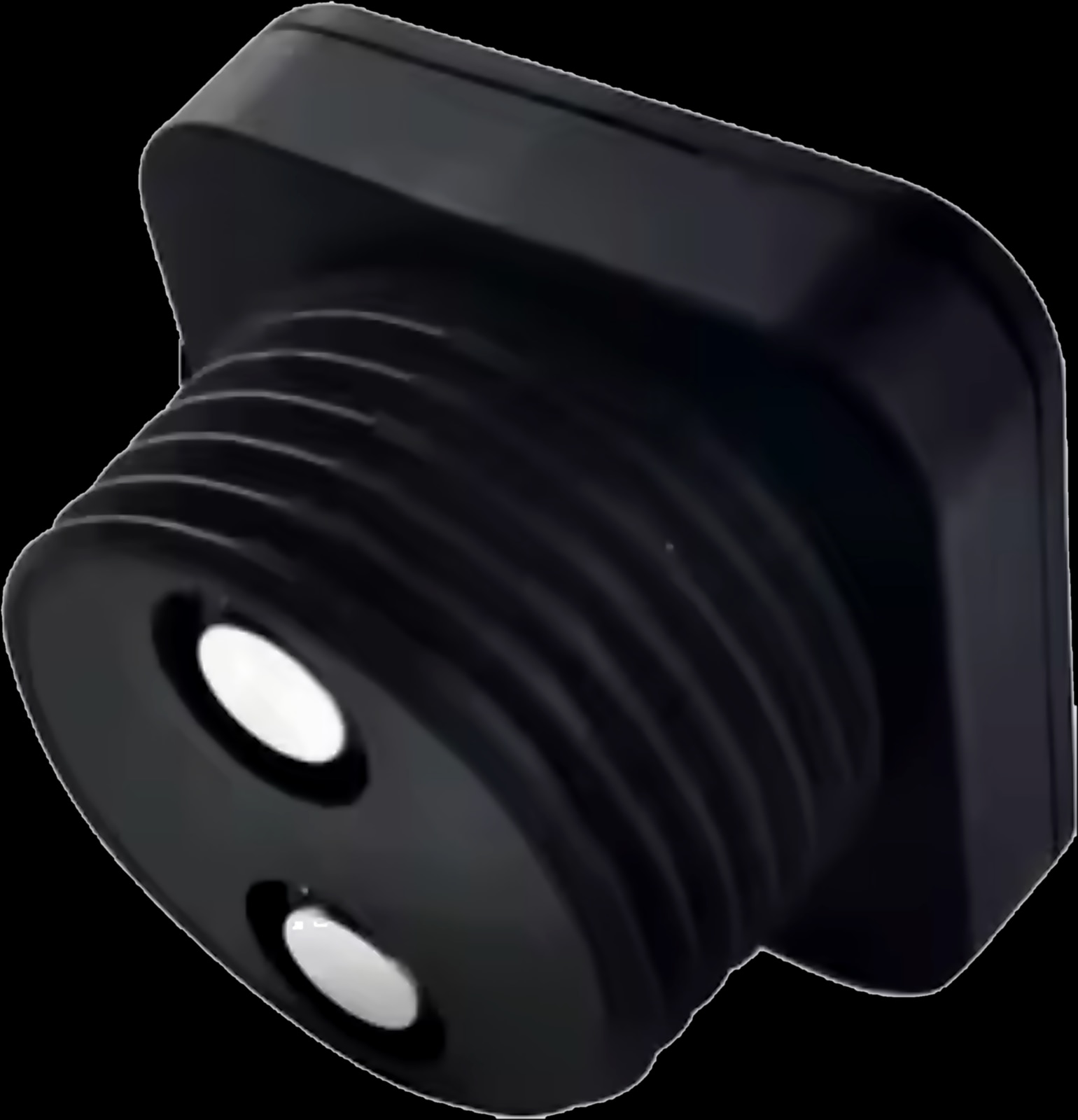
- WL-30 Water Level Sensor: rated for water and oil tanks, on your home Wi-Fi.
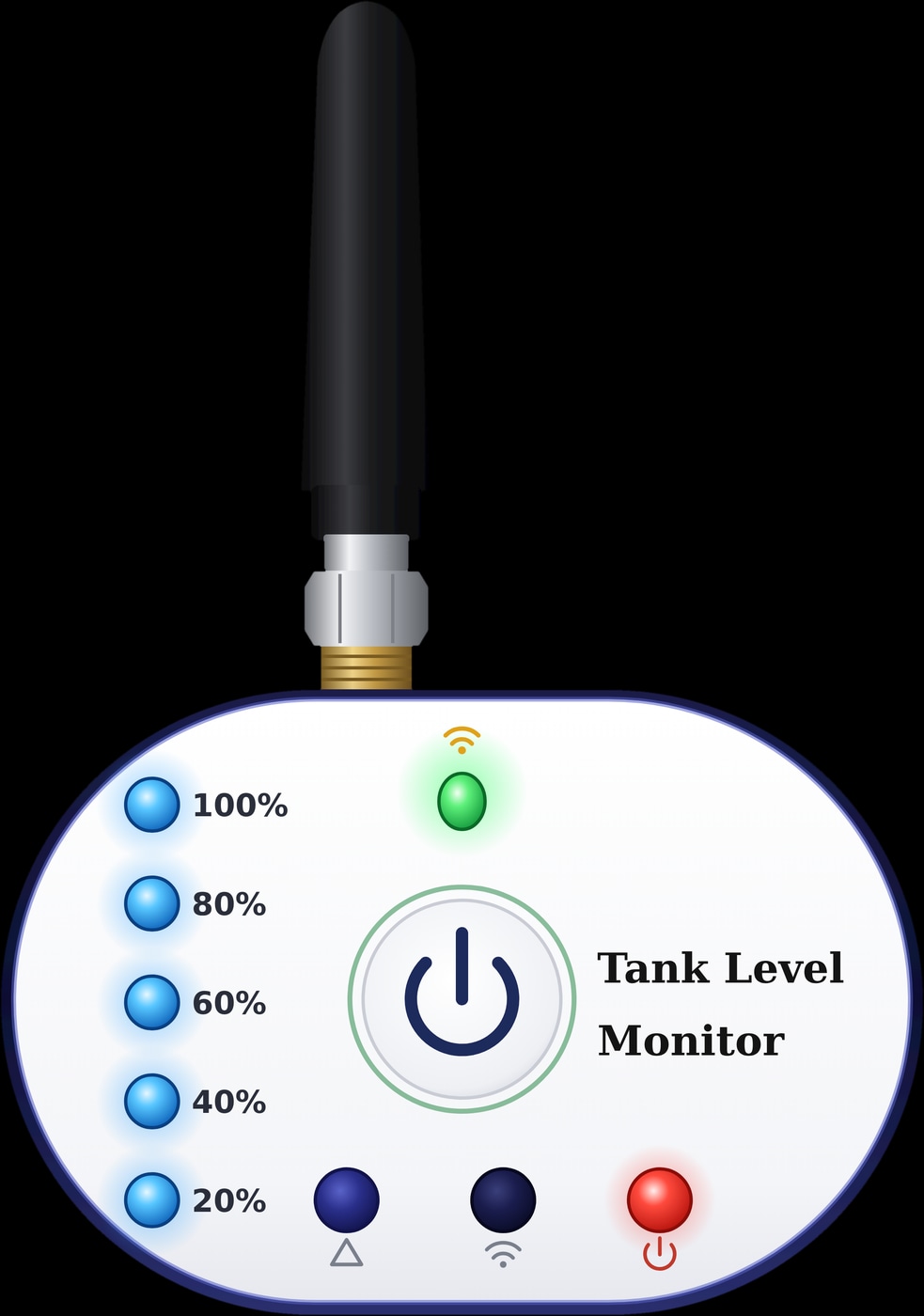
- WL-100 Tank Level Monitor: rated for water, oil and other liquids, with a receiver indoors.
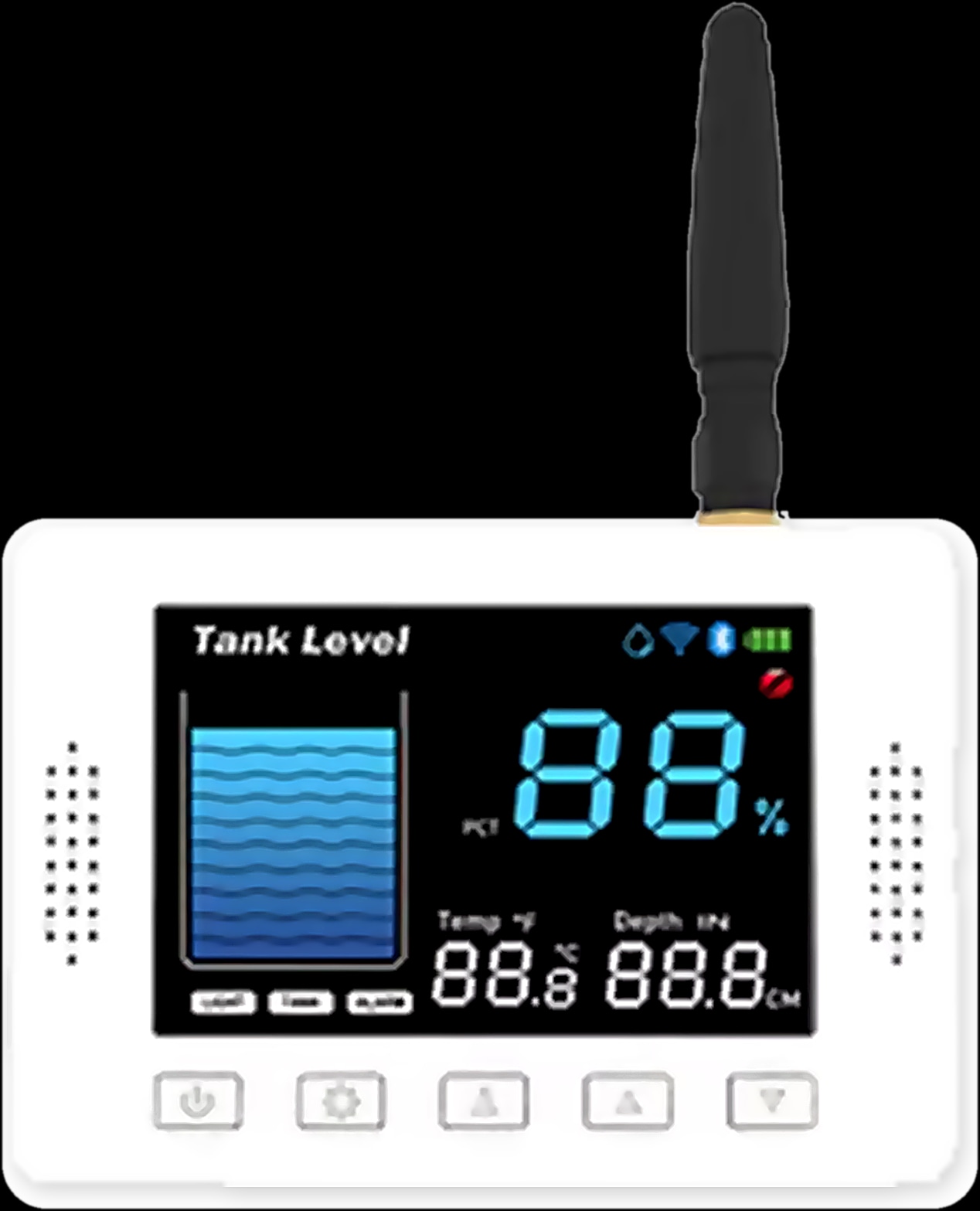
- WL-50 Tank Level Monitor: its page lists no liquids and calls the reading water depth. Its display and pump control are covered in our water tank level sensor guide.
| Feature | WL-30 | WL-100 | WL-50 |
|---|---|---|---|
| Liquids listed | Water and oil | Water, oil and other liquids | None listed; reads water depth |
| Measuring range | 10 cm to 2.9 m | 40 cm to 10 m | 10 cm to 5 m |
| Gap above the highest level | At least 0.1 m | At least 40 cm | At least 0.1 m |
| Tank to house | Wi-Fi from the sensor | LoRa to an indoor receiver | LoRa to an indoor display on 2.4 GHz Wi-Fi |
| Where you read it | App: %, depth, status and history | Five receiver lights; exact level and depth in the app | Colour display and app |
| Alarms | High and low, notified through a Tuya Smart scene | High and low in the app, even when you are away | Buzzer above Max or below Min |
For a heating tank, depth and Wi-Fi decide: up to 2.9 m from sensor to bottom suits the WL-30, up to 10 m the WL-100. On a shallow tank filled close to the top, the WL-100's 40 cm blind area is a real limit.
The pages rate these sensors for oil, but not for every tank shape, opening or fuel, so a Spark partner confirms the fit for your tank before you buy.
The Spark tank level sensors compared here
How an ultrasonic oil tank sensor measures without touching the fuel
An ultrasonic oil tank sensor measures distance with sound. It sends a pulse down from the top of the tank, the surface of the liquid sends an echo back, and the echo gives the distance, which the app shows as a level percentage and a depth.
Nothing touches the liquid: there is no float to stick and nothing hanging in the diesel. The sensor only needs a clear view of the surface, so it reads best when:
- It points straight down, perpendicular to the liquid surface.
- It sits away from the inlet and the walls, because falling liquid and nearby walls cause false echoes.
- Nothing blocks the beam: no tilted surfaces, small objects or foam under it.
Oil tank monitor with Wi-Fi or LoRa: which connection fits your tank?
If your Wi-Fi reaches the tank, the WL-30 connects to it directly. If it doesn't, the WL-100 sends the level by LoRa radio to a receiver indoors, and only the receiver needs Wi-Fi. A heating tank is rarely next to the router: it may be in the yard, in a basement boiler room or on the roof.
WL-30: an oil tank monitor on your Wi-Fi
The WL-30 reports to the Tuya Smart or Smart Life app, and you pair it from a phone on the same Wi-Fi with Bluetooth on. With sleep mode on, it measures for 28 seconds every 2 minutes, which suits a level that falls slowly, though during a delivery the reading trails the filling.
WL-100: LoRa to a receiver indoors
Five blue lights on the WL-100 receiver show the level in steps of 20, 40, 60, 80 and 100%. For the exact level ratio and depth, open the app.
Neither model needs a Zigbee hub. The Hub-Z gateway brings Zigbee devices into the app and runs local scenes between them offline, but these two sensors use Wi-Fi and LoRa, not Zigbee.
How to install a level sensor on a heating oil tank
Any fuel tank level sensor of this kind needs an opening in the tank top, a clear spot above the fuel and power nearby. Work in this order:
- 1
Confirm the fit
Tell a Spark partner what the tank holds, how deep it is, where it sits and what openings it has on top.
- 2
Measure the height
From the sensor position to the bottom: up to 2.9 m for the WL-30, 10 m for the WL-100. Keep at least 0.1 m (WL-30) or 40 cm (WL-100) between the sensor and the highest fuel level.
- 3
Pick the spot
Near the centre of the tank top, away from the filler inlet and the walls.
- 4
Fit the sensor
The WL-30 screws into a hole of about 58 mm with its 2¼-inch thread. The WL-100 probe screws through the top, pointing straight down.
- 5
Plan the power
The WL-30 uses a plug-in adapter, so plan a socket within reach. The WL-100 receiver has its own adapter indoors; a Spark partner confirms how its tank sensor is powered.
- 6
Pair and set the levels
Pair the WL-30 with Bluetooth on, enter the installation height and the sensor-to-full-line distance, then set Max and Min. On the WL-100, choose the high and low levels in the app.
Low-level alarms: hear about it before the diesel runs out
Set the low level high enough to leave time for a delivery, and the high level just below full.
On the WL-30, set Min and Max, then add a Tuya Smart scene that sends a notification when the level status changes. The WL-100 sends its high or low level notification through the app, even when you are away.
Where to set the low level
There is no single right number: it depends on your tank and on how quickly your home burns fuel in the coldest weeks. Here the WL-30 works as a smart oil tank gauge. Its app keeps the level history by day, month and year, so after a few cold weeks you can see how fast the level falls and move Min to leave enough days for the delivery.
The high alarm is not a shut-off
A high level alert helps you confirm a delivery, but the sensor does not stop the delivery or close a valve, so whoever fills the tank still watches the fill.
Check your heating oil level from your phone, or from abroad
Both sensors put the reading in the Tuya Smart app, and Smart Life works too. With the WL-30 you can put a sensor on each tank, see them together and share access with family, so the diesel tank sits beside the water tanks in one app.
From abroad, the reading reaches you only while the house has power and internet, because it travels over the home Wi-Fi. Our guide to managing your Jordan home from abroad covers what else you can check while you are away.
Heating oil and the thermostat: running the boiler on a schedule
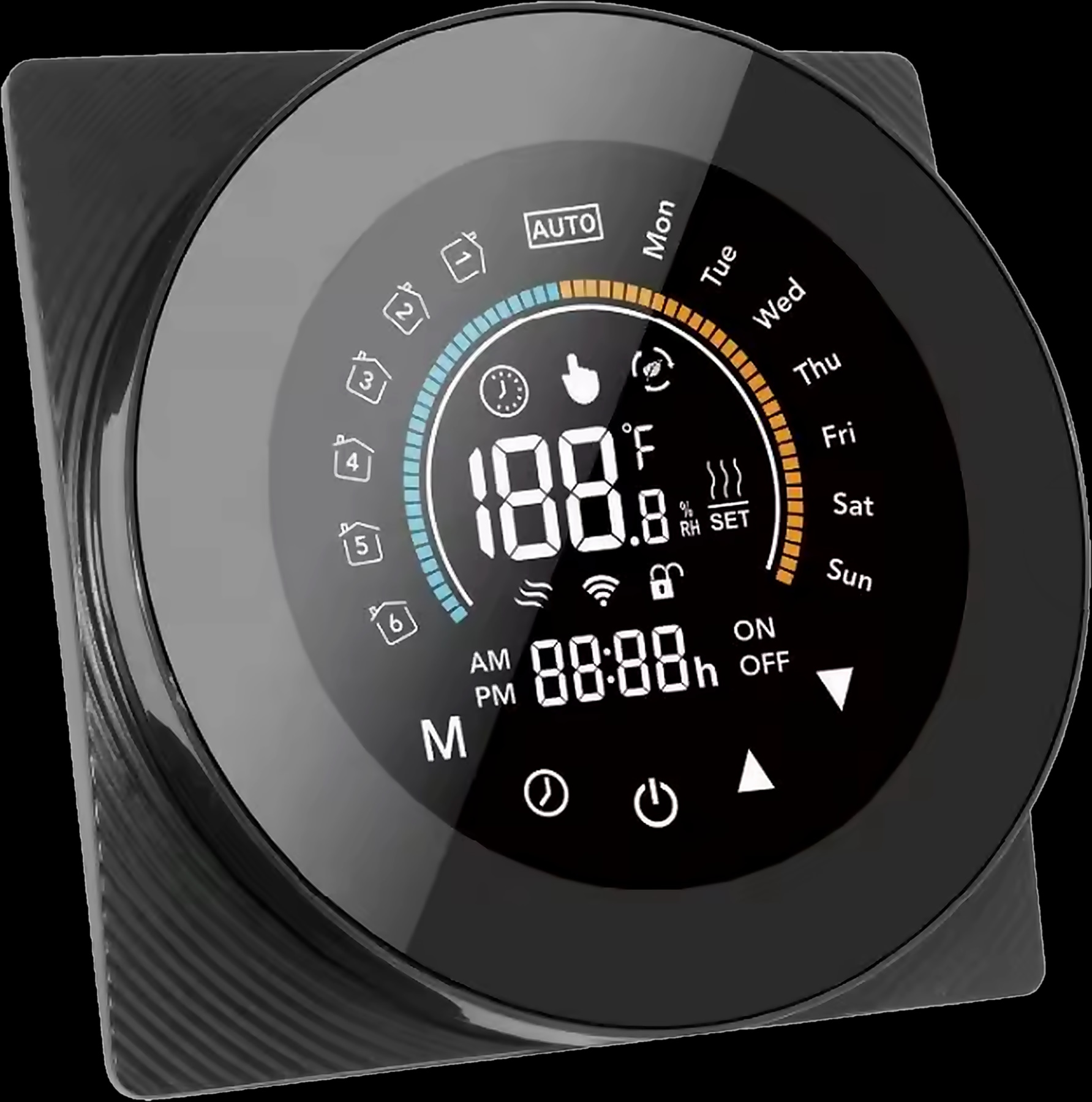
A level sensor tells you what is in the tank; a thermostat decides when the boiler draws on it. The Spark T-50 thermostat runs a 7-day programme with up to 6 periods a day, plus manual and energy saving modes, from the Tuya Smart app.
Its GC version is made for a gas boiler, which it starts and stops through a dry contact, so if your boiler burns diesel, ask a Spark partner to confirm the right version first. The Zigbee version joins through a gateway such as the Hub-Z, and setup is covered in our underfloor heating thermostat settings guide.
For the tank and the boiler
Questions people ask about heating oil tank sensors
How do I check my heating oil level?
By hand, with a dipstick or the tank's own gauge, if it has one. With a Spark WL-30 or WL-100 on the tank, you read the level in the Tuya Smart app instead and get an alert when it runs low.
Can an ultrasonic sensor measure diesel?
Spark rates the WL-30 for water and oil tanks and the WL-100 for water, oil and other liquids, and both measure without touching the liquid. A Spark partner confirms the fit for your specific fuel tank.
Is there a WiFi oil tank monitor?
Yes. The WL-30 connects straight to your home Wi-Fi. If Wi-Fi doesn't reach the tank, choose the WL-100: only its indoor receiver needs Wi-Fi.
Does an oil tank sensor show how many litres are left?
No. The Spark pages give the reading as a level percentage and a depth; use the depth with your tank's dimensions or chart to estimate litres.
Can I use the WL-50 on a diesel tank?
Its page lists no liquids and calls the reading water depth, so for a diesel tank choose the WL-30 or the WL-100.
Can one app show my water tank and my diesel tank?
Yes, with one sensor per tank: the WL-30 lets you see several tanks together in one app and share access with family.